• Skip to primary navigation
  • Skip to main content
The Office of Religious Congregations for Integral Ecology

The Office of Religious Congregations for Integral Ecology

  • About Us
    • Our Story
    • Integral Ecology
    • Our Team
    • Members
    • Testimonials
  • Our Work
    • Climate Policy National
    • Climate Policy International
    • Reconciliation
    • Ecological Debt
  • Activities & Updates
  • Resources
  • Newsletter
    • E-Newsletter Sign-up
  • Contact Us

Ecological Debt

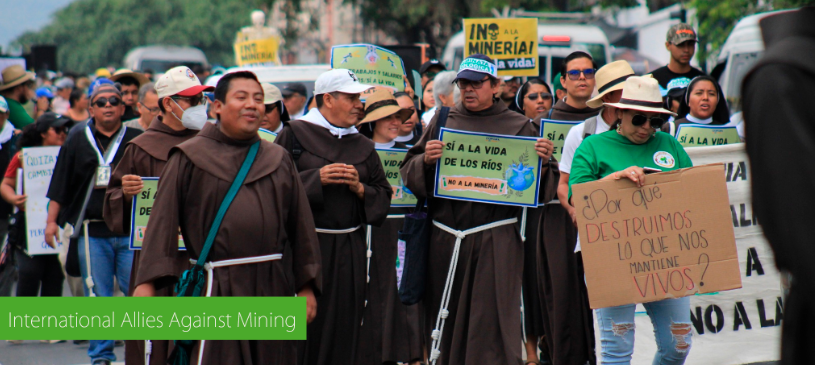
ORCIE Endorses Open Letter by Faith Organizations in Support of Preserving El Salvador’s Historic Ban on Metals Mining

August 18, 2025

The Office of Religious Congregations for Integral Ecology (ORCIE) is pleased to share that we have officially endorsed the Open Letter by Faith Organizations in Support of Preserving El Salvador’s Historic Ban on Metals Mining. This collective statement urges governments to uphold the decision of the people of El Salvador and their church institutions to protect their land, water, and communities from the devastating impacts of metallic mining.

We, the undersigned, from a diversity of church structures(representing local, regional, and national expressions of churches and related agencies),express our steadfast support for the people of El Salvador and their religious institutions and leaders who are struggling to maintain their country’s historic ban on metal mining –in place from 2017 to 2024 — so all Salvadorans can enjoy their God-given right to clean water.  We stand in solidarity with civic and religious leaders who are being persecuted and imprisoned for working against injustices, including the devastation that metals mining would cause their communities…”

We encourage our members to join us in this important initiative by signing on behalf of your congregation. Adding your voice amplifies the call from people of faith who are advocating for ecological justice and the defense of communities most at risk.

📅 Deadline to sign: September 1, 2025

👉 Read and sign the open letter here

Together, our collective witness can amplify the moral voice of the people of El Salvador in their call for justice and the care for creation.
Forging the Path Ahead: Insights from the People’s Forum

August 11, 2025

How can we expand our reach with the Jubilee Turn Debt Into Hope campaign?

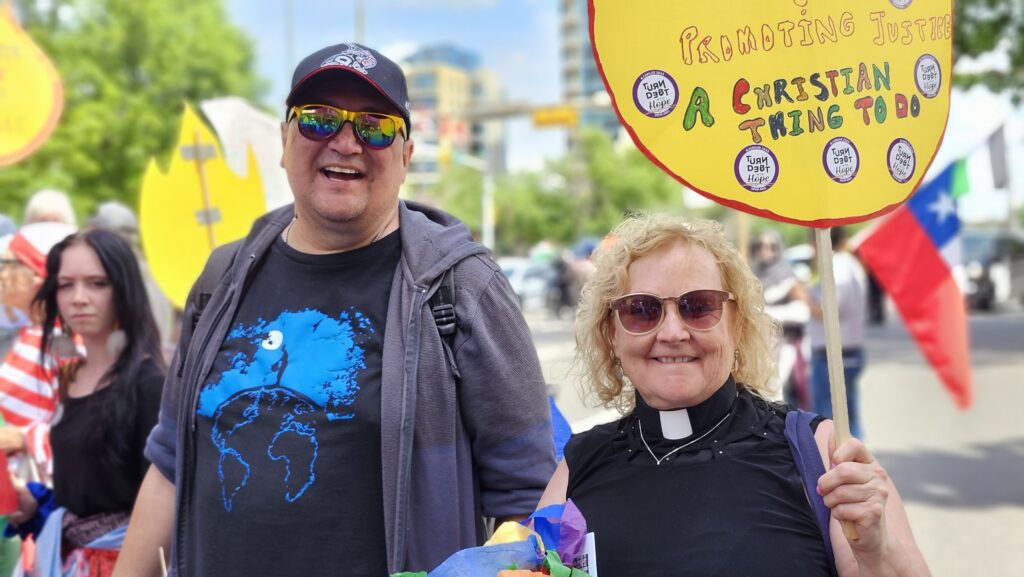
At the G7 Jubilee People’s Forum in Calgary this past June, ORCIE joined over 100 participants, social justice activists and people of faith from across Canada to call for global debt justice. Just four months after the Turn Debt Into Hope campaign was launched, the People’s Forum offered two key elements that demonstrate practical ways forward for the movement for debt justice.

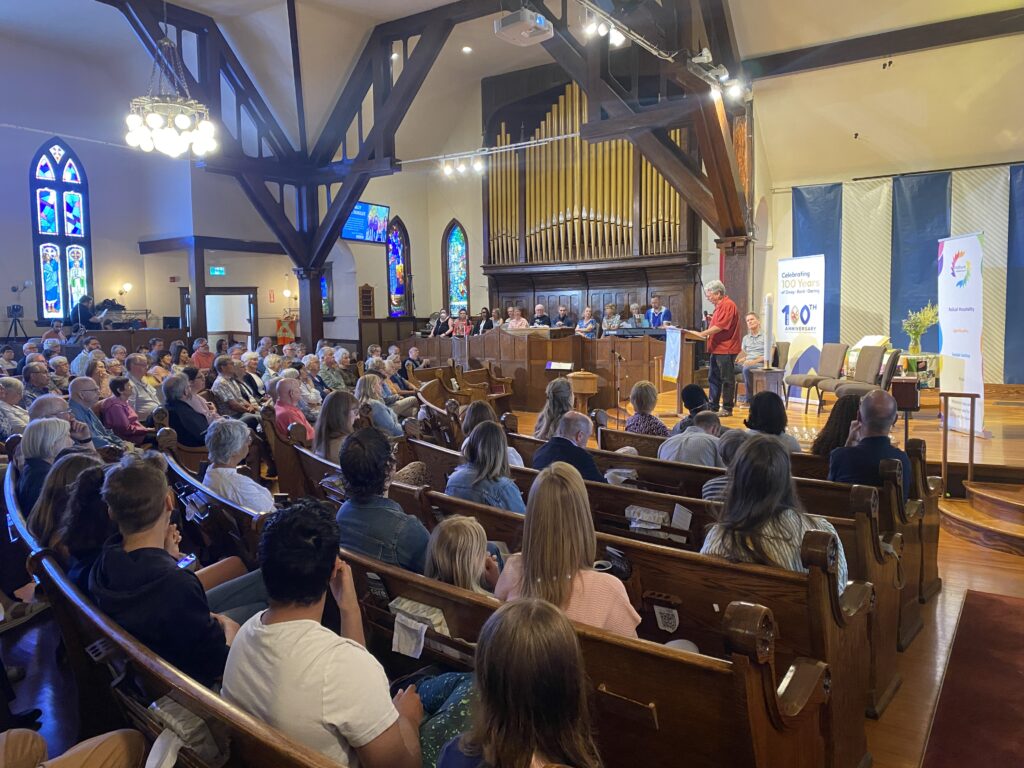
The G7 Jubilee People’s Forum began with a dynamic Interfaith Service where multiple faith traditions prayed for justice in the Jubilee year. Led by the Calgary Interfaith Council, the service included voices and elements from Muslim, Hindu, Indigenous, Jewish, Buddhist, Bahai, Sikh, Unitarian and Christian traditions, followed by a meal from the community kitchen of the Calgary Sikh gurdwara. The Council, 30 years strong, not only focuses on deepening relationships across faith traditions, but they also urge members of their community to educate themselves, become advocates for peace and justice, and pave the way for integrated coexistence for future generations. Members of the Council did not just participate in the first evening but stayed throughout the Forum and deepened their engagement with the Jubilee campaign. It was a vivid example to the ecumenical movement of the need to expand our relationships and work beyond our own faith and cultural communities.

In Christian communities we often invite one or two other faith traditions to join the existing group, expecting newcomers to adapt to the group’s own history and way of doing things. Instead, what if we reach out to local interfaith groups, to create and build relationships that could lead to collaboration? Or what are the local Christian cultural communities, not necessarily part of the mainline churches, who we have neglected to include in our ecumenical work?

The city of Calgary is on the traditional territories of the Peoples of Treaty 7, which include the Blackfoot Confederacy (comprised of the Siksika, the Piikani, and the Kainai First Nations), the Tsuut’ina First Nation, and the Stoney Nakoda (including Chiniki, Bearspaw, and Goodstoney First Nations). Calgary is also home to the Métis Nation of Alberta.

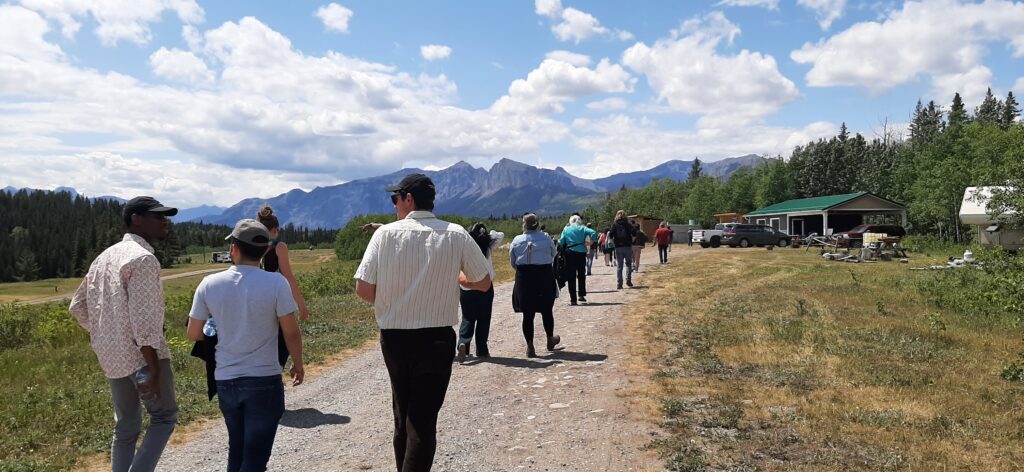
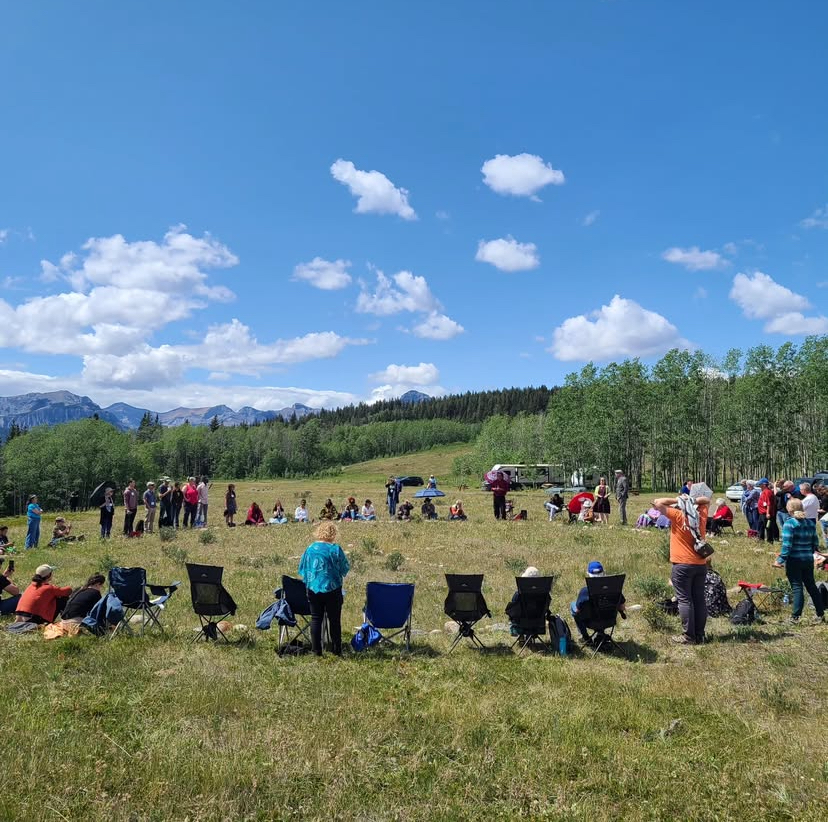
With a desire to go beyond land acknowledgements, each day of the Forum included dedicated time for an opening session by an Elder from the three main nations. A high point of the weekend was travelling to Mînî Thnî for an interfaith prayer meeting on sacred ground at the Stoney Nakoda First Nations Medicine Wheel. Leaving the classrooms to see the stunning mountains, the prairie flowers and the Bow River allowed for deeper integration of mind, heart and spirit.

Reverend Tony Snow and Elders from the Bearspaw, Chiniki and Goodstoney First Nations joined the interfaith circle at Mnî Thnî to lift up prayers for the Jubilee vision for the world.  Rev. Tony: “Built by Elders from the Ecumenical circle, the Medicine Wheel commemorates the journey of restoration that our people have traveled to honour the wisdom of our ancestors. In this space we invite interfaith prayer and ceremony to lead us. In this sacred space we bring hopes and dreams, guided by the wisdom of many traditions.”  Alongside education and strategizing at the Forum, creating space for Indigenous Elders to share their wisdom and for each person to set foot on sacred Indigenous land provided us a chance to catch our breath, to taste a decolonized Christianity, and be stunned by the glory of creation. This time of integration set a strong foundation for the action steps where participants spoke about debt justice in local churches and rallied in the streets of Calgary.

The Fair Share Platform for Global Climate Equity

July 23, 2025

ORCIE has joined organizations from across Canadian civil society to call upon the government of Canada to fulfill our fair share of the global effort to confront the climate crisis.

Canada cannot take on the climate crisis alone. As one of the world’s top polluters and wealthiest countries, we must do our fair share globally, not just at home. As the 30th annual UN Climate Change Conference (COP30) approaches, Prime Minister Carney has a generational opportunity and responsibility to lead boldly on climate justice, economic transformation, and international solidarity.

Why this matters

The climate emergency was created and is accelerated by a deeply unjust global economic system that is unfairly distorted against Indigenous communities and the Global South. The time has come to reckon with Canada’s role in the international community. Canada can show leadership in supporting energy transitions around the world. We can also help transform unfair systems that have become barriers to climate action.

Doing our fair share means building a new package of support to the international community from the Canadian government – rooted in justice and led by social movements.

  1. Triple Canada’s climate finance to support the Global South with grants, not loans.
  2. Cancel unjust Global South debt and free billions for climate solutions.
  3. Make big polluters and the ultra-rich pay their fair share. 
  4. End trade rules that undermine climate action. 

Individuals are encouraged to sign the petition to send these demands to the Prime Minister and key cabinet ministers.

Religious congregations are invited to sign on as an organization and can do so through this form.

Read the full platform for a detailed breakdown of how Canada can do its part in the global climate fight. The Platform is a living document that is growing and evolving as our Fair Share movement expands.

Climate Leadership from Churches of the Global South

July 4, 2025

It has often been remarked that, in the days before the 2013 Conclave that elected him as pope, Jorge Bergoglio told the Cardinals that, “The church is called to come out of herself and to go to the peripheries, not only geographically, but also the existential peripheries…”

Over decade later, these “peripheries” turned the tables – they arrived at the metropole to deliver their own historic challenge to all Christians, especially those of us in the Global North. Could anyone have predicted what topic would be their churches’ utmost priority?

Global warming has been defined as “an existential issue of justice, dignity and care for our common home.”

In a press conference at the Vatican on July 1, 2025, three Cardinals, presidents of their regional organizations, presented a message from the Catholic Episcopal Conferences and Councils of Africa, Asia, Latin America and the Caribbean on the occasion of COP30 (the UN conference on climate change, scheduled for Brazil in November 2025.) Their 30-page text is titled, “A Call for Climate Justice and the Common Home: Ecological Conversion, Transformation and Resistance to False Solutions.”

This year marks the 10th anniversary of the publication of Francis’ encyclical, Laudato Si, as well as the legally binding treaty at COP21 in Paris that famously committed 196 nation signatories to limit global warming to an increase under 1.5 degrees Celsius. Nonetheless, the bishops call for a profound ecological conversion because global warming already reached a 1.55 degrees C increase in 2024.

They “demand the phasing out of fossil fuels,” using strong language to reject all new exploration, exploitation, and infrastructure: “In the context of the climate collapse we are experiencing, it is seriously contradictory to use profits from oil extraction to finance what is presented as an energy transition, without any effective commitment to overcoming it.”

They “condemn ‘green capitalism’ mining and energy monoculture which sacrifice communities and ecosystems” and “demand a radical economic transformation that favours conditions for life on Earth to thrive.” Indeed, “the growing rhetoric that the solution lies in expanding mining, especially for the extraction of minerals considered “critical” and rare earths, is ecologically unsustainable, unjust and predatory.” This is an echo of Francis’ 2024 message to the last COP, Laudate Deum, in which he wrote, “We must move beyond the mentality of appearing to be concerned but not having the courage needed to produce substantial changes.” (LD #56)

They want to see “zero deforestation in all biomes by 2030” (a commitment already adopted at COP16 on Biodiversity in 2021) and receive assurances that international finance institutions no longer invest in fossil fuels and extractive projects.”

However, the churches of the Global South do more than denounce our current situation.

ENG_The Churches Global South on ocassion of COP30Download
FRA_Les Églises des pays du Sud à l’occasion de la COP30Download

In their “Calls to Action” the bishops demand that rich countries “recognize and assume their social and ecological debt as the main actors responsible for extracting natural resources and emitting greenhouse gases.” In doing this they demand “reparations” – commitment to “fair, accessible and effective” climate finance that “does not generate more debt.” They repeat the January 1, 2025, Jubilee Year call of Francis to “cancel or significantly reduce the debts of the poorest countries.”

They prophetically oppose unfettered markets. Specifically, they “reject the ‘false solutions’ of the financialization and commodification of nature” and “stand up to carbon offset schemes” that “unfairly shift the burden of reducing emissions from those who cause them to those who suffer them and put profit before life; and which perpetuate the exploitation of the earth, its living beings, and its peoples, instead of addressing the causes of the crisis.”

Several rather predictable steps are offered for the churches themselves to take up, such as education for members, ongoing dialogues with scientific evidence and “sobriety as resistance to consumerism.” But especially innovative is the announcement that “as a sign of lasting commitment, we are launching the Ecclesial Observatory on Climate Justice.” Notably, this new institute will not be located in Rome under the Vatican but promoted by the Ecclesial Conference of the Amazon. The initiative will surely deepen the ability of the churches to monitor and encourage the fulfilment of COP agreements and call out non-compliance.

Importantly, the text also calls for the establishment of “a historic coalition” with “coherent allies from all sectors and countries of the Global North committed to ethics, equity and justice.” To my ears, this sounds like an invitation that the congregational members of ORCIE are going to be most definitely proud to accept!

Joe Gunn serves as Treasurer of ORCIE.

ORCIE at the G7 Jubilee People’s Forum: Connecting the Dots on Debt Cancellation and Climate Justice

July 2, 2025

From July 12–15, ORCIE was proud to join voices from across the globe at the G7 Jubilee People’s Forum in Calgary, where Chair of the Board Sue Wilson and Executive Director Genevieve Gallant represented our shared commitment to integral ecology and economic justice.

Held in the days leading up to the G7 Summit in Alberta, the Jubilee Peoples’ Forum in Calgary brought together people from across Canada to explore how debt cancellation, financial system reform, development issues, climate change, and ecological debt are deeply connected—and why, as Sue Wilson reflects, these challenges must be addressed concurrently.

ORCIE, along with KAIROS, Development and Peace – Caritas Canada, Citizens for Public Justice, and the Canadian Council of Churches came together at the Jubilee People’s Forum to deepen our understanding of the interconnectedness of global debt, ecological harm, climate justice, and systemic inequality.

“Who Owes Whom?”: Understanding the Debt Trap

As Development and Peace vice-president Tashia Toupin aptly put it, the issue of debt can feel overwhelming—politically, economically, culturally, and ideologically. Yet the Forum helped to demystify these dynamics, showing how unjust debt, particularly in the Global South, is both a result of and contributor to structural inequality. ORCIE Chair Sue Wilson helped unpack these complex relationships through a lens of integral ecology.

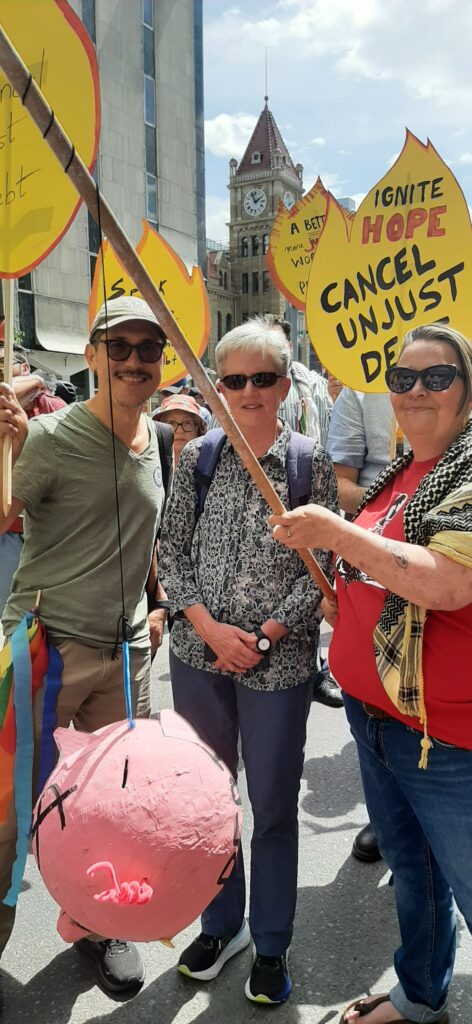
“At the rally, a bystander came up to me and said, ‘Your group is concerned about a lot of issues.’ I looked at the signs the people around me were holding: Turn Debt into Hope. Climate Justice. Reform the Financial System. People before Profit. Who owes whom? Where he saw different issues, I saw the multifaceted and interconnected aspects of the Jubilee Debt Campaign.” — Sue Wilson, CSJ

Sue emphasized how unsustainable debt in the Global South is often driven by:

  • Global economic shocks such as the COVID-19 pandemic and war in Ukraine;
  • Predatory lending practices by private financial institutions;
  • International systems that force countries to prioritize debt repayments over development;
  • Lack of global rules on responsible borrowing and lending.

Debt cancellation, then, is not charity. It’s a form of justice—especially when viewed through the lens of ecological debt, the concept that the Global North countries, including Canada, owes a climate and resource debt to the South and Indigenous communities due to centuries of exploitation and emissions.

“This is not charity, but a commitment made in the 2015 Paris Agreement which states that countries must fund global climate actions according to their responsibility for the climate crisis and their ability to pay. Countries like Canada (wealthy, large historic climate polluter, and a key producer of crude oil and gas) must contribute our fair share towards addressing the impacts of climate change in the Global South (Canada’s Fair Share Platform).”
— Sue Wilson, CSJ

Read Sue’s full analysis here: Connecting the Dots: Jubilee People’s Forum and The Debt Cancellation Campaign | Sue Wilson

Let us continue connecting the dots—between faith, finance, and the future—and transforming systems that exploit into systems that heal.

  • « Go to Previous Page
  • Page 1
  • Page 2
  • Page 3
  • Go to Next Page »
  • About Us
  • Our Work
  • Activities & Updates
  • Resources
  • Newsletter
  • Contact Us

The Office of Religious Congregations for Integral Ecology

© The Office of Religious Congregations for Integral Ecology | Log in

Built by PeaceWorks

We acknowledge, with respect and humility, that our office is situated on the traditional and unceded territory of the Algonquin Anishinabeg peoples.