
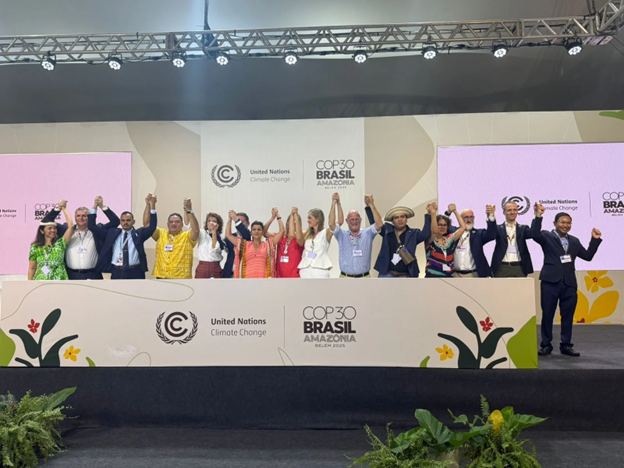
The first Conference on Transitioning Away from Fossil Fuels (TAFF) in Santa Marta, Colombia brought together 57 countries and a wide range of stakeholders to focus on one question: how to move from global commitments to implementation on transitioning away from fossil fuels.
What the conference is — and is not
Santa Marta is a sustained political platform for implementation-oriented cooperation among countries ready to advance an orderly fossil fuel phase-out. It is complementary to the UNFCCC process and contributes to broader climate roadmaps while enabling more practical, cross-country collaboration.
It is not a replacement for the UNFCCC or COP processes, not a negotiation space for a fossil fuel treaty, and not designed to convince skeptics.
Key outcomes
The conference delivered several important results, including:
- a second TAFF conference in 2027, co-hosted by Tuvalu and Ireland;
- a coordination mechanism to maintain momentum and link with COP processes;
- three implementation workstreams on transition roadmaps, financial and macroeconomic barriers, and producer–consumer cooperation;
- and the launch of a Science Panel on the Global Energy Transition.
Why this matters
Santa Marta highlights that the transition away from fossil fuels is increasingly about implementation challenges: debt, fiscal dependency, investment gaps, energy access, and just transition pathways. These issues sit at the centre of Catholic advocacy on ecological justice, particularly where economic and social inequality intersect with climate action.
The process also reinforces the importance of people-centred transitions, including worker participation, Indigenous rights, and community-led energy access.
Read here some of the key outcomes from the conference: Santa Marta: Key outcomes from first summit on ‘transitioning away’ from fossil fuels – Carbon Brief
Looking ahead
Santa Marta is part of a broader trajectory toward COP31, and the next TAFF conference in Tuvalu in 2027, where progress on implementation workstreams will be assessed and further shaped.
As ORCIE considers its role moving forward, several questions will guide our work:
- What priority emerging from Santa Marta should shape ORCIE’s advocacy over the next six months?
- How is ORCIE positioning its advocacy and partnerships in light of these outcomes toward COP31, and TAFF2 in Tuvalu?
- What is the greatest opportunity for Catholic coordination ahead of TAFF2, and how might ORCIE integrate?
This week, ORCIE will continue discussions with partners in the Climate Action Network (CAN-Rac) to explore coordinated responses and shared advocacy strategies.