
News
Climate Leadership from Churches of the Global South

It has often been remarked that, in the days before the 2013 Conclave that elected him as pope, Jorge Bergoglio told the Cardinals that, “The church is called to come out of herself and to go to the peripheries, not only geographically, but also the existential peripheries…”
Over decade later, these “peripheries” turned the tables – they arrived at the metropole to deliver their own historic challenge to all Christians, especially those of us in the Global North. Could anyone have predicted what topic would be their churches’ utmost priority?
Global warming has been defined as “an existential issue of justice, dignity and care for our common home.”
In a press conference at the Vatican on July 1, 2025, three Cardinals, presidents of their regional organizations, presented a message from the Catholic Episcopal Conferences and Councils of Africa, Asia, Latin America and the Caribbean on the occasion of COP30 (the UN conference on climate change, scheduled for Brazil in November 2025.) Their 30-page text is titled, “A Call for Climate Justice and the Common Home: Ecological Conversion, Transformation and Resistance to False Solutions.”
This year marks the 10th anniversary of the publication of Francis’ encyclical, Laudato Si, as well as the legally binding treaty at COP21 in Paris that famously committed 196 nation signatories to limit global warming to an increase under 1.5 degrees Celsius. Nonetheless, the bishops call for a profound ecological conversion because global warming already reached a 1.55 degrees C increase in 2024.
They “demand the phasing out of fossil fuels,” using strong language to reject all new exploration, exploitation, and infrastructure: “In the context of the climate collapse we are experiencing, it is seriously contradictory to use profits from oil extraction to finance what is presented as an energy transition, without any effective commitment to overcoming it.”
They “condemn ‘green capitalism’ mining and energy monoculture which sacrifice communities and ecosystems” and “demand a radical economic transformation that favours conditions for life on Earth to thrive.” Indeed, “the growing rhetoric that the solution lies in expanding mining, especially for the extraction of minerals considered “critical” and rare earths, is ecologically unsustainable, unjust and predatory.” This is an echo of Francis’ 2024 message to the last COP, Laudate Deum, in which he wrote, “We must move beyond the mentality of appearing to be concerned but not having the courage needed to produce substantial changes.” (LD #56)
They want to see “zero deforestation in all biomes by 2030” (a commitment already adopted at COP16 on Biodiversity in 2021) and receive assurances that international finance institutions no longer invest in fossil fuels and extractive projects.”
However, the churches of the Global South do more than denounce our current situation.
In their “Calls to Action” the bishops demand that rich countries “recognize and assume their social and ecological debt as the main actors responsible for extracting natural resources and emitting greenhouse gases.” In doing this they demand “reparations” – commitment to “fair, accessible and effective” climate finance that “does not generate more debt.” They repeat the January 1, 2025, Jubilee Year call of Francis to “cancel or significantly reduce the debts of the poorest countries.”
They prophetically oppose unfettered markets. Specifically, they “reject the ‘false solutions’ of the financialization and commodification of nature” and “stand up to carbon offset schemes” that “unfairly shift the burden of reducing emissions from those who cause them to those who suffer them and put profit before life; and which perpetuate the exploitation of the earth, its living beings, and its peoples, instead of addressing the causes of the crisis.”
Several rather predictable steps are offered for the churches themselves to take up, such as education for members, ongoing dialogues with scientific evidence and “sobriety as resistance to consumerism.” But especially innovative is the announcement that “as a sign of lasting commitment, we are launching the Ecclesial Observatory on Climate Justice.” Notably, this new institute will not be located in Rome under the Vatican but promoted by the Ecclesial Conference of the Amazon. The initiative will surely deepen the ability of the churches to monitor and encourage the fulfilment of COP agreements and call out non-compliance.
Importantly, the text also calls for the establishment of “a historic coalition” with “coherent allies from all sectors and countries of the Global North committed to ethics, equity and justice.” To my ears, this sounds like an invitation that the congregational members of ORCIE are going to be most definitely proud to accept!
Joe Gunn serves as Treasurer of ORCIE.
ORCIE at the G7 Jubilee People’s Forum: Connecting the Dots on Debt Cancellation and Climate Justice

From July 12–15, ORCIE was proud to join voices from across the globe at the G7 Jubilee People’s Forum in Calgary, where Chair of the Board Sue Wilson and Executive Director Genevieve Gallant represented our shared commitment to integral ecology and economic justice.
Held in the days leading up to the G7 Summit in Alberta, the Jubilee Peoples’ Forum in Calgary brought together people from across Canada to explore how debt cancellation, financial system reform, development issues, climate change, and ecological debt are deeply connected—and why, as Sue Wilson reflects, these challenges must be addressed concurrently.
ORCIE, along with KAIROS, Development and Peace – Caritas Canada, Citizens for Public Justice, and the Canadian Council of Churches came together at the Jubilee People’s Forum to deepen our understanding of the interconnectedness of global debt, ecological harm, climate justice, and systemic inequality.
“Who Owes Whom?”: Understanding the Debt Trap
As Development and Peace vice-president Tashia Toupin aptly put it, the issue of debt can feel overwhelming—politically, economically, culturally, and ideologically. Yet the Forum helped to demystify these dynamics, showing how unjust debt, particularly in the Global South, is both a result of and contributor to structural inequality. ORCIE Chair Sue Wilson helped unpack these complex relationships through a lens of integral ecology.
“At the rally, a bystander came up to me and said, ‘Your group is concerned about a lot of issues.’ I looked at the signs the people around me were holding: Turn Debt into Hope. Climate Justice. Reform the Financial System. People before Profit. Who owes whom? Where he saw different issues, I saw the multifaceted and interconnected aspects of the Jubilee Debt Campaign.” — Sue Wilson, CSJ
Sue emphasized how unsustainable debt in the Global South is often driven by:
- Global economic shocks such as the COVID-19 pandemic and war in Ukraine;
- Predatory lending practices by private financial institutions;
- International systems that force countries to prioritize debt repayments over development;
- Lack of global rules on responsible borrowing and lending.
Debt cancellation, then, is not charity. It’s a form of justice—especially when viewed through the lens of ecological debt, the concept that the Global North countries, including Canada, owes a climate and resource debt to the South and Indigenous communities due to centuries of exploitation and emissions.
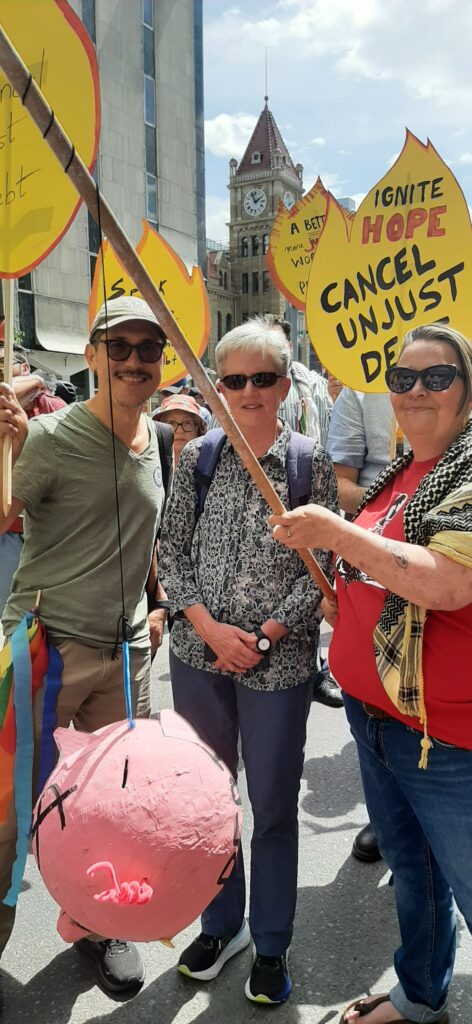
“This is not charity, but a commitment made in the 2015 Paris Agreement which states that countries must fund global climate actions according to their responsibility for the climate crisis and their ability to pay. Countries like Canada (wealthy, large historic climate polluter, and a key producer of crude oil and gas) must contribute our fair share towards addressing the impacts of climate change in the Global South (Canada’s Fair Share Platform).”
— Sue Wilson, CSJ
Read Sue’s full analysis here: Connecting the Dots: Jubilee People’s Forum and The Debt Cancellation Campaign | Sue Wilson
Let us continue connecting the dots—between faith, finance, and the future—and transforming systems that exploit into systems that heal.

Join Our Partners for a Global Town Hall: Pilgrims of Hope
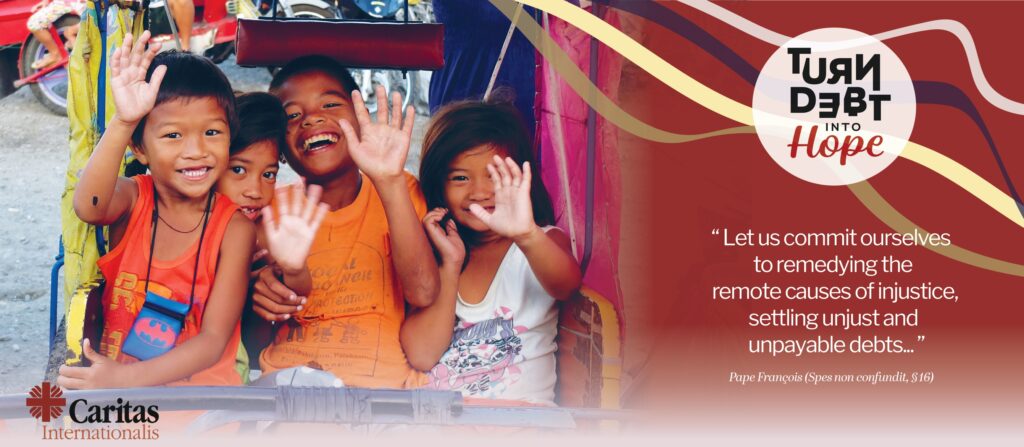
A Jubilee Inspiration for Action on Debt, Climate, and Development
🗓️ May 28, 2025
🕝 2:30 PM CEST
📍 Online (Zoom)
Click here to register
ORCIE is honored to stand in solidarity with Caritas Internationalis and the Holy See Dicastery for Promoting Integral Human Development as they host a special global town hall: Pilgrims of Hope.
Marking the 10th anniversary of Laudato Si’ and celebrating the 2025 Jubilee Year, this event invites us into a shared space of reflection and action on the pressing, interconnected issues of debt, climate justice, and sustainable development.
At a time when the call for Jubilee justice resounds more urgently than ever, this conversation gathers faith leaders, civil society actors, and global institutions to chart a hopeful path forward. We’re grateful for the leadership of our partners in convening this vital dialogue—and we hope you’ll join us in listening, learning, and acting together.
🌍 Let’s journey as pilgrims of hope, building a more just and sustainable future for all.
📬 For inquiries, contact: Alfonso Apicella | Caritas Internationalis | apicella@caritas.va