• Skip to primary navigation
  • Skip to main content
The Office of Religious Congregations for Integral Ecology

The Office of Religious Congregations for Integral Ecology

  • About Us
    • Our Story
    • Integral Ecology
    • Our Team
    • Members
    • Testimonials
  • Our Work
    • Climate Policy National
    • Climate Policy International
    • Reconciliation
    • Ecological Debt
  • Activities & Updates
  • Resources
  • Newsletter
    • Media
    • E-Newsletter Sign-up
  • Contact Us

News

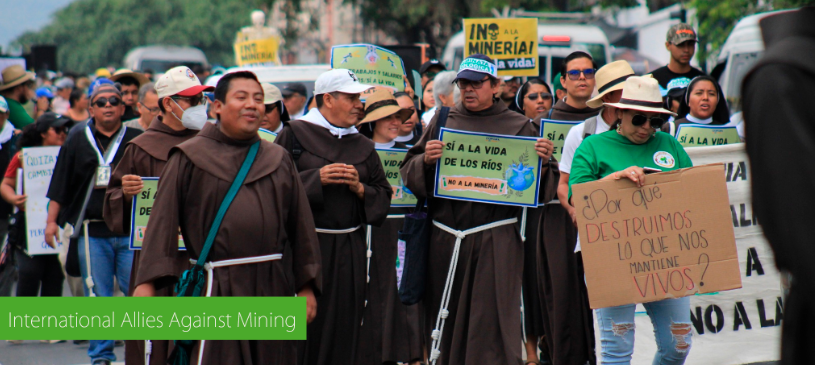
ORCIE Endorses Open Letter by Faith Organizations in Support of Preserving El Salvador’s Historic Ban on Metals Mining

August 18, 2025 Filed Under: Activities, Advocacy, News, Take Action

The Office of Religious Congregations for Integral Ecology (ORCIE) is pleased to share that we have officially endorsed the Open Letter by Faith Organizations in Support of Preserving El Salvador’s Historic Ban on Metals Mining. This collective statement urges governments to uphold the decision of the people of El Salvador and their church institutions to protect their land, water, and communities from the devastating impacts of metallic mining.

We, the undersigned, from a diversity of church structures(representing local, regional, and national expressions of churches and related agencies),express our steadfast support for the people of El Salvador and their religious institutions and leaders who are struggling to maintain their country’s historic ban on metal mining –in place from 2017 to 2024 — so all Salvadorans can enjoy their God-given right to clean water.  We stand in solidarity with civic and religious leaders who are being persecuted and imprisoned for working against injustices, including the devastation that metals mining would cause their communities…”

We encourage our members to join us in this important initiative by signing on behalf of your congregation. Adding your voice amplifies the call from people of faith who are advocating for ecological justice and the defense of communities most at risk.

📅 Deadline to sign: September 1, 2025

👉 Read and sign the open letter here

Together, our collective witness can amplify the moral voice of the people of El Salvador in their call for justice and the care for creation.

Climate Leadership from Churches of the Global South

July 4, 2025 Filed Under: Communications, News

It has often been remarked that, in the days before the 2013 Conclave that elected him as pope, Jorge Bergoglio told the Cardinals that, “The church is called to come out of herself and to go to the peripheries, not only geographically, but also the existential peripheries…”

Over decade later, these “peripheries” turned the tables – they arrived at the metropole to deliver their own historic challenge to all Christians, especially those of us in the Global North. Could anyone have predicted what topic would be their churches’ utmost priority?

Global warming has been defined as “an existential issue of justice, dignity and care for our common home.”

In a press conference at the Vatican on July 1, 2025, three Cardinals, presidents of their regional organizations, presented a message from the Catholic Episcopal Conferences and Councils of Africa, Asia, Latin America and the Caribbean on the occasion of COP30 (the UN conference on climate change, scheduled for Brazil in November 2025.) Their 30-page text is titled, “A Call for Climate Justice and the Common Home: Ecological Conversion, Transformation and Resistance to False Solutions.”

This year marks the 10th anniversary of the publication of Francis’ encyclical, Laudato Si, as well as the legally binding treaty at COP21 in Paris that famously committed 196 nation signatories to limit global warming to an increase under 1.5 degrees Celsius. Nonetheless, the bishops call for a profound ecological conversion because global warming already reached a 1.55 degrees C increase in 2024.

They “demand the phasing out of fossil fuels,” using strong language to reject all new exploration, exploitation, and infrastructure: “In the context of the climate collapse we are experiencing, it is seriously contradictory to use profits from oil extraction to finance what is presented as an energy transition, without any effective commitment to overcoming it.”

They “condemn ‘green capitalism’ mining and energy monoculture which sacrifice communities and ecosystems” and “demand a radical economic transformation that favours conditions for life on Earth to thrive.” Indeed, “the growing rhetoric that the solution lies in expanding mining, especially for the extraction of minerals considered “critical” and rare earths, is ecologically unsustainable, unjust and predatory.” This is an echo of Francis’ 2024 message to the last COP, Laudate Deum, in which he wrote, “We must move beyond the mentality of appearing to be concerned but not having the courage needed to produce substantial changes.” (LD #56)

They want to see “zero deforestation in all biomes by 2030” (a commitment already adopted at COP16 on Biodiversity in 2021) and receive assurances that international finance institutions no longer invest in fossil fuels and extractive projects.”

However, the churches of the Global South do more than denounce our current situation.

ENG_The Churches Global South on ocassion of COP30Download
FRA_Les Églises des pays du Sud à l’occasion de la COP30Download

In their “Calls to Action” the bishops demand that rich countries “recognize and assume their social and ecological debt as the main actors responsible for extracting natural resources and emitting greenhouse gases.” In doing this they demand “reparations” – commitment to “fair, accessible and effective” climate finance that “does not generate more debt.” They repeat the January 1, 2025, Jubilee Year call of Francis to “cancel or significantly reduce the debts of the poorest countries.”

They prophetically oppose unfettered markets. Specifically, they “reject the ‘false solutions’ of the financialization and commodification of nature” and “stand up to carbon offset schemes” that “unfairly shift the burden of reducing emissions from those who cause them to those who suffer them and put profit before life; and which perpetuate the exploitation of the earth, its living beings, and its peoples, instead of addressing the causes of the crisis.”

Several rather predictable steps are offered for the churches themselves to take up, such as education for members, ongoing dialogues with scientific evidence and “sobriety as resistance to consumerism.” But especially innovative is the announcement that “as a sign of lasting commitment, we are launching the Ecclesial Observatory on Climate Justice.” Notably, this new institute will not be located in Rome under the Vatican but promoted by the Ecclesial Conference of the Amazon. The initiative will surely deepen the ability of the churches to monitor and encourage the fulfilment of COP agreements and call out non-compliance.

Importantly, the text also calls for the establishment of “a historic coalition” with “coherent allies from all sectors and countries of the Global North committed to ethics, equity and justice.” To my ears, this sounds like an invitation that the congregational members of ORCIE are going to be most definitely proud to accept!

Joe Gunn serves as Treasurer of ORCIE.

ORCIE at the G7 Jubilee People’s Forum: Connecting the Dots on Debt Cancellation and Climate Justice

July 2, 2025 Filed Under: Advocacy, Communications, Media, News, Take Action

From July 12–15, ORCIE was proud to join voices from across the globe at the G7 Jubilee People’s Forum in Calgary, where Chair of the Board Sue Wilson and Executive Director Genevieve Gallant represented our shared commitment to integral ecology and economic justice.

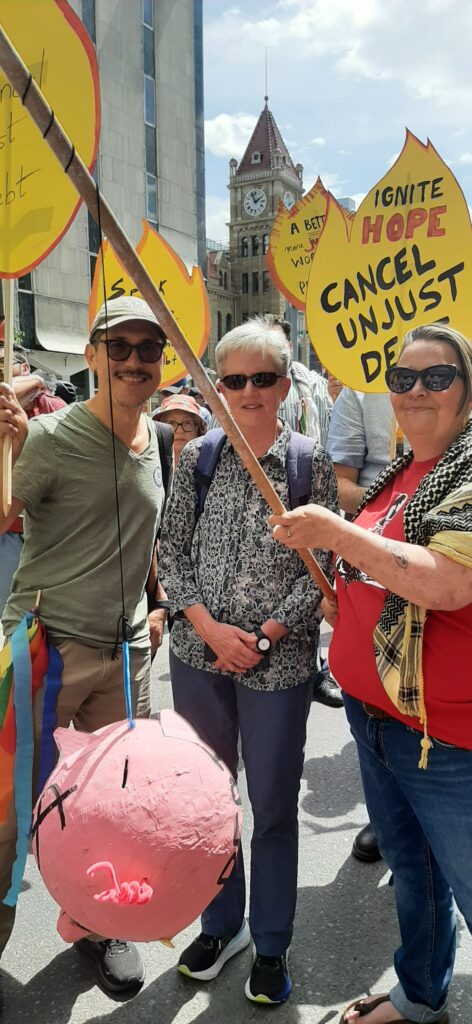
Held in the days leading up to the G7 Summit in Alberta, the Jubilee Peoples’ Forum in Calgary brought together people from across Canada to explore how debt cancellation, financial system reform, development issues, climate change, and ecological debt are deeply connected—and why, as Sue Wilson reflects, these challenges must be addressed concurrently.

ORCIE, along with KAIROS, Development and Peace – Caritas Canada, Citizens for Public Justice, and the Canadian Council of Churches came together at the Jubilee People’s Forum to deepen our understanding of the interconnectedness of global debt, ecological harm, climate justice, and systemic inequality.

“Who Owes Whom?”: Understanding the Debt Trap

As Development and Peace vice-president Tashia Toupin aptly put it, the issue of debt can feel overwhelming—politically, economically, culturally, and ideologically. Yet the Forum helped to demystify these dynamics, showing how unjust debt, particularly in the Global South, is both a result of and contributor to structural inequality. ORCIE Chair Sue Wilson helped unpack these complex relationships through a lens of integral ecology.

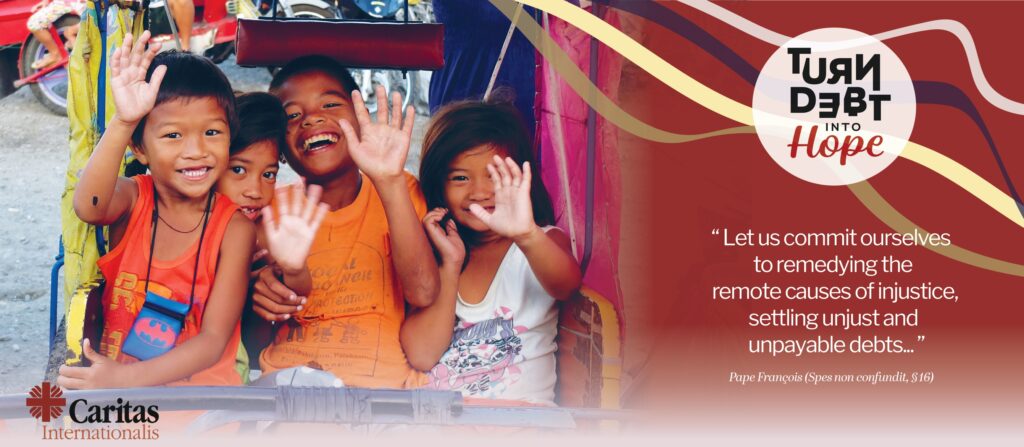
“At the rally, a bystander came up to me and said, ‘Your group is concerned about a lot of issues.’ I looked at the signs the people around me were holding: Turn Debt into Hope. Climate Justice. Reform the Financial System. People before Profit. Who owes whom? Where he saw different issues, I saw the multifaceted and interconnected aspects of the Jubilee Debt Campaign.” — Sue Wilson, CSJ

Sue emphasized how unsustainable debt in the Global South is often driven by:

  • Global economic shocks such as the COVID-19 pandemic and war in Ukraine;
  • Predatory lending practices by private financial institutions;
  • International systems that force countries to prioritize debt repayments over development;
  • Lack of global rules on responsible borrowing and lending.

Debt cancellation, then, is not charity. It’s a form of justice—especially when viewed through the lens of ecological debt, the concept that the Global North countries, including Canada, owes a climate and resource debt to the South and Indigenous communities due to centuries of exploitation and emissions.

“This is not charity, but a commitment made in the 2015 Paris Agreement which states that countries must fund global climate actions according to their responsibility for the climate crisis and their ability to pay. Countries like Canada (wealthy, large historic climate polluter, and a key producer of crude oil and gas) must contribute our fair share towards addressing the impacts of climate change in the Global South (Canada’s Fair Share Platform).”
— Sue Wilson, CSJ

Read Sue’s full analysis here: Connecting the Dots: Jubilee People’s Forum and The Debt Cancellation Campaign | Sue Wilson

Let us continue connecting the dots—between faith, finance, and the future—and transforming systems that exploit into systems that heal.

Join Our Partners for a Global Town Hall: Pilgrims of Hope

May 23, 2025 Filed Under: Advocacy, News, Take Action

A Jubilee Inspiration for Action on Debt, Climate, and Development
🗓️ May 28, 2025
🕝 2:30 PM CEST
📍 Online (Zoom)
Click here to register

ORCIE is honored to stand in solidarity with Caritas Internationalis and the Holy See Dicastery for Promoting Integral Human Development as they host a special global town hall: Pilgrims of Hope.

Marking the 10th anniversary of Laudato Si’ and celebrating the 2025 Jubilee Year, this event invites us into a shared space of reflection and action on the pressing, interconnected issues of debt, climate justice, and sustainable development.

At a time when the call for Jubilee justice resounds more urgently than ever, this conversation gathers faith leaders, civil society actors, and global institutions to chart a hopeful path forward. We’re grateful for the leadership of our partners in convening this vital dialogue—and we hope you’ll join us in listening, learning, and acting together.

🌍 Let’s journey as pilgrims of hope, building a more just and sustainable future for all.

📬 For inquiries, contact: Alfonso Apicella | Caritas Internationalis | apicella@caritas.va

Jubilee 2000 Memories

March 3, 2025 Filed Under: News, Take Action

By Joe Gunn

Opening the doors of St. Peter’s Basilica in Rome at the midnight Mass on Christmas Eve 2024, Pope Francis launched the Jubilee Year 2025. The symbolic gesture indicated that this pope wants Jubilee commemorations to move beyond prayer in our churches – he’s calling us to step out into specific actions in global societies.

Under the theme “Pilgrims of Hope,” perhaps 35 million devout visitors will descend upon Rome throughout the year, in search of a promised plenary indulgence. But Francis hopes Christians will also promote peacebuilding in a world threatened by climate change and wars. The Pontiff urged nations to eliminate the death penalty and to cancel debts of countries of the Global South.

Some readers of a certain age might remember the Jubilee Year 2000, which also highlighted campaigns to cancel odious debts of poor countries. What did we learn back then? And what must we do differently – or better – in 2025, if we are to achieve more lasting results?

Memories of Jubilee 2000

Launched in March 1997, the Canadian Ecumenical Jubilee Initiative (CEJI) had enough time to ramp up effective research, education and advocacy strategies before the new millennium. Resonating with the biblical texts of Leviticus 25: 10-17, we agreed on three prominent Jubilee themes: Release from Bondage, Redistribution of Wealth, and Renewal of the Earth. Although best remembered for impactful campaigning on the international debt issue, CEJI also campaigned subsequently on child poverty in Canada, restoring land to Indigenous peoples and climate change.

CEJI established a Working Group to coordinate activities and strategies. It was based in the centre of the Canadian ecumenical universe… remember: at that time there were a dozen ecumenical coalitions funded by the major Christian churches… all but two were located in Toronto. Because we eventually brought together 37 member organizations, it was seen to be necessary to convene every meeting somewhere on the Toronto Transit system. In those days, as the Director of the Social Affairs Desk of the Canadian Conference of Catholic Bishops, I was often the guy who traveled the furthest; these almost monthly trips to “the Canadian Mecca” resulted in important relationship-building.

CEJI established a Vision Statement early in our work, which served as a unifying force in all the campaigns. A bilingual theology conference was organized in Montreal – it was one of the very few national initiatives hosted outside of Toronto – if memory serves, at the Congregation de Notre Dame convent on rue Sherbrooke. A theology committee published three books. These were not all theoretical pieces – some entries were sermons delivered by different preachers in language any congregant could understand.

And CEJI’s educational work was unprecedented: some 350,000 pamphlets on debt issues were circulated, and 120,400 educational posters distributed (almost 1 for every church in Canada!). Some 16,185 leadership guides were also provided to activists; 114 communities intentionally pledged themselves to be “Jubilee communities.”

Over 640,000 signatures were affixed to our petition calling for the cancelation of international debts – in those early-Internet days, it was the largest hard copy petition in Canadian history!

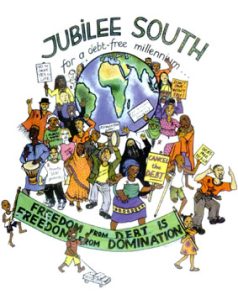
Strategically, we recognized early on that such an international campaign should not be led by activists in the Global North. CEJI helped finance meetings between southern activists, who eventually established “Jubilee South” and pushed for much more radical, just responses from the World Bank and International Monetary Fund. The Canadian campaign worked in tandem with leaders like Nicaragua’s Alejandro Bendana, whom I had known as Director General of that country’s Foreign Ministry. Ale holds a PhD from Harvard and was comfortable doing several speaking tours in Canada, coming to CEJI meetings, visiting Members of Parliament and having long chats into the night at our home.

By listening to the voices of those most affected by onerous debt repayment schemes that were demanded of the “Least Developed Countries” CEJI rejected the “Highly-Indebted Poor Country Initiative (HIPC)” of the powerful international finance institutions. The HIPC Initiative promised debt “relief” – not cancellation. And the measures were accompanied by various forms of conditionality known as “structural adjustment programs” (SAPs). For example, to renegotiate its debt, Uganda was forced to privatize its potable water services – hardly a benefit for the poor.

So while the international campaign resulted in $100 billion in debt “relief” it is no surprise that here we are two and half decades later, facing the on-going debt crisis that Pope Francis has denounced. “…to break the bonds of injustice and to proclaim God’s justice. Sporadic acts of philanthropy are not enough. Cultural and structural changes are necessary, so that enduring change may come about.” Wealthy lenders were allowed to set the conditions of loans and their repayment – at gain to themselves. A periodic Jubilee cannot be successful if the rules remain exploitative of the poor.

I vividly remember delivering a sermon on the Jubilee call for debt cancelation in a church one Sunday. Before leaving the altar, the priest addressed the congregation: “I don’t know if you noticed, but the Finance Minister was at Mass this morning.” After hesitating for effect, the pastor continued: “Well, he’s gone from the back row now, but you can be sure he got our message!”

Advocacy for change can be done in many ways!

CEJI Working Group member Jennifer Henry recounts a related “famous story” of those times. Apparently, Finance Minister Paul Martin used to say he “couldn’t go into a church in Canada during that period without being buttonholed about the debt issue.” She goes on to explain “What was striking about that was that the Finance Minister of Britain was experiencing the same thing. They would show up at the G8 meetings together with this collective pressure. And so what happened, due to this combination of lobbying, policy analysis and grassroots engagement, was that we got 100% bilateral debt cancellation from Canada, and we moved some benchmarks globally.”

Essential to our efforts was getting the mainstream media to reproduce CEJI’s messages. I recall driving to Toronto with our children, planning to celebrate Christmas with my aging parents. But CBC Radio called, and off I sped to do an interview with the lovely host, Shelagh Rogers, who was quite interested in international debt issues herself. (I remember telling of how health spending was less than debt repayment in Nicaragua, where I knew of pregnant moms forced to sleep two to a bed in hospitals, and rely on their families to bring them food.) Later, a bishop in Nova Scotia wrote to tell me how pleased he was to hear the interview – and here I had thought all bishops spent Sunday mornings in church!

Jubilee 2025 Anticipation

There are going to be some substantial differences between the activities carried out in 2000 and what we might be able to achieve in 2025.

While we were once invited to meet with Finance Ministers like Paul Martin and Ralph Goodale for pre-budget conversations, two substantial things have changed. It is not at all clear that the churches have undertaken the preliminary and necessary research into current Canadian policies related to international debt issues. Added to this, the political situation on Parliament Hill is extremely unstable as we enter the new year. While we can all promote the international petition on debt cancelation, there is no specific Canadian text in 2025. We have more work to do…

Also, the situation of indebtedness has changed – more debt is now being held by private investors, as opposed to governments and international institutions. Different campaign targets are necessary to bring impactful results.

And different from 2000, ecological debt is an issue that has today achieved international attention. Many poorer countries and peoples are facing a climate crisis they did little to create. November’s COP29 in Baku failed to obtain commitments to reach the target of $1.3 trillion in climate financing – imagine what international debt negotiations will obtain. Since wealthy countries did commit to raise $300 billion annually by 2035 for climate financing, requests for substantial action on debt financing may face strong headwinds.

Nonetheless, Canadian church activists recall that we did have some successes in 2000. After what seemed like endless discussions perhaps, we did achieve common analyses and agreements. We saw that campaigns succeed best at bringing faith-based communities together when they are theologically based. We also learned we need multiyear campaigns, with perhaps a year of preparation for research and production of educational materials – a successful campaign cannot just end in 2025. Surely successful campaigning today will be more electronic than our work a quarter decade ago. And like before, we must develop campaigns that are led by insightful voices of advocates – not just victims – working in the Global South. We cannot assume we are the architects of their liberation.

A broad commitment of many actors to a Jubilee 2025 campaign could be an energizing way to allow faith communities to collaborate on a series of focussed actions. It has been done before, but as Isaiah 43:19 challenges us, “I am doing a new thing; do you not see it? …now it springs up. Do you not perceive it?”

After all, there are some lessons to learn if we hope to avoid repeating the same calls to action in 2050!


  • « Go to Previous Page
  • Page 1
  • Page 2
  • Page 3
  • Go to Next Page »
  • About Us
  • Our Work
  • Activities & Updates
  • Resources
  • Newsletter
  • Contact Us

The Office of Religious Congregations for Integral Ecology

© The Office of Religious Congregations for Integral Ecology | Log out

Built by PeaceWorks

We acknowledge, with respect and humility, that our office is situated on the traditional and unceded territory of the Algonquin Anishinabeg peoples.